
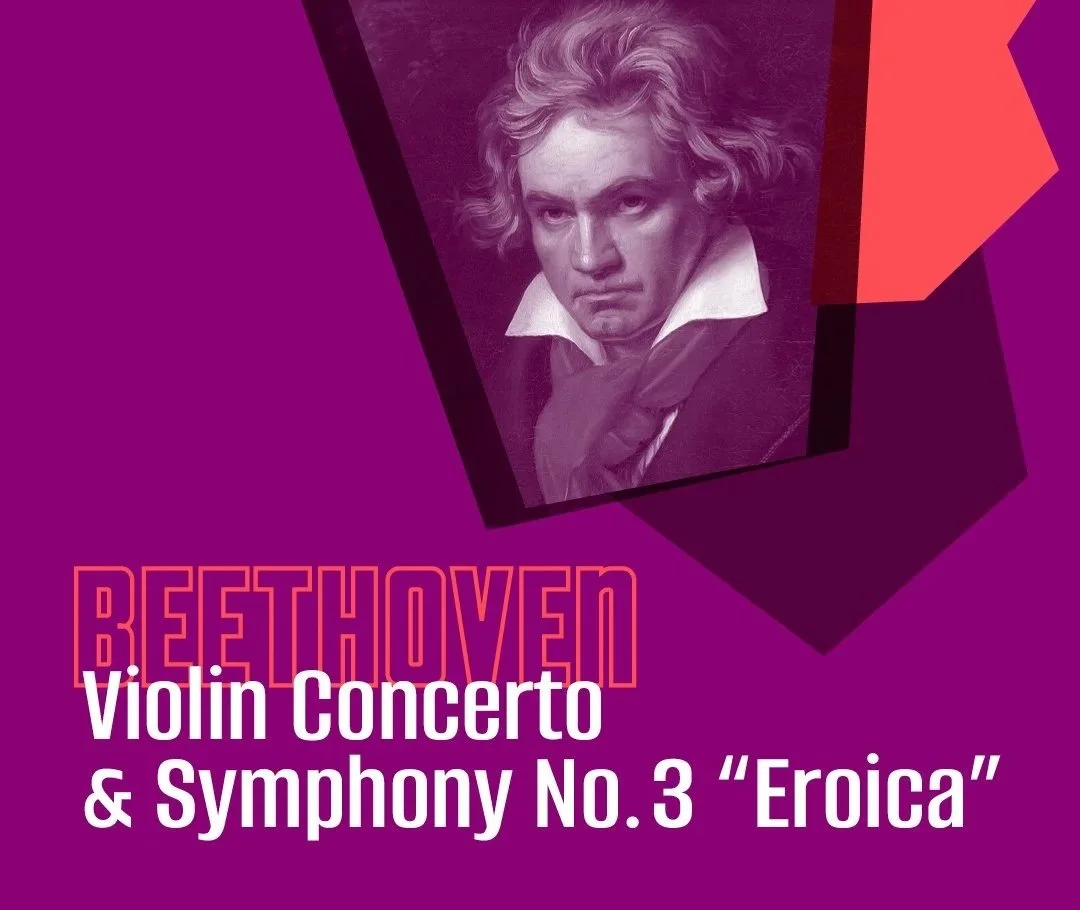
Violin Concerto (Duration: 42 minutes)
Ludwig van Beethoven
Julian Rhee, Violin
IntermissionSymphony No. 3 “Eroica” (Duration: 47 minutes)
Ludwig van Beethoven
Profound emotion and heroic triumph define this powerful evening of music, performed just in time for Valentine’s Day. Violinist Julian Rhee, winner of the 2024 Avery Fisher Career Grant, takes center stage for Beethoven’s soaring Violin Concerto. Praised for his refinement, beauty of sound, and “the kind of poise and showmanship that thrills audiences.” (The Strad) The night culminates with Beethoven’s revolutionary Symphony No. 3 “Eroica”, a bold and powerful work that changed music forever. Don’t miss this unforgettable journey through passion, brilliance, and transformation!
Tickets start at $22 with $10 student/youth tickets.
This concert is generously sponsored by


If you’re attending the concert, a printed program book will be available for you at the door. In the meantime, you’re welcome to preview the digital version here.
Looking for more in-depth program notes? Explore more detailed program notes below.
-
Beethoven’s Violin Concerto stands as one of the most quietly revolutionary works in the concerto repertoire, a piece that reshaped expectations not through spectacle, but through scale, proportion, and an almost philosophical patience. Composed in 1806 during a period of remarkable creative expansion, the concerto belongs to the same fertile moment that produced the Fourth Symphony, the “Appassionata” Sonata, and the Razumovsky quartets. Across these works, Beethoven was stretching Classical forms toward something more expansive and psychologically complex.
Yet the concerto’s premiere was notoriously underprepared. Written for the celebrated violinist Franz Clement, the solo part was reportedly completed so late that Clement had little time to rehearse. Viennese audiences, accustomed to virtuosic display pieces filled with rapid passagework and theatrical flair, were instead confronted with a work of symphonic breadth and introspective lyricism. Its cool reception delayed its acceptance until the young Joseph Joachim revived it in 1844, revealing its true stature.
What makes this concerto extraordinary is Beethoven’s rebalancing of power between soloist and orchestra. Rather than positioning the violin as a protagonist battling the ensemble, Beethoven creates a shared musical ecosystem in which ideas emerge organically. Virtuosity is present, but it is always in service of line, architecture, and expressive inevitability.
The concerto begins with one of the most understated gestures in orchestral literature: five pianissimo taps of the timpani outlining the interval of a fourth. This rhythmic cell proves foundational, quietly permeating the movement. It is a striking example of Beethoven’s ability to derive monumental structures from minimal material — a compositional approach that anticipates later symphonic thinking.
The orchestra unfolds the principal themes before the soloist enters, but unlike in earlier Classical concertos, this orchestral exposition is not merely preparatory; it is symphonic in weight. When the violin finally appears, it does not announce itself with bravura. Instead, it seems to grow out of the orchestral texture, elaborating rather than interrupting the musical argument.
The first movement’s architecture is vast, often described as symphonic rather than concertante. Beethoven favors long-breathed melodies that test a performer’s ability to sustain tonal beauty across extended spans. Harmonic motion is deliberate, frequently delaying resolution in ways that heighten expressive tension. Even moments of technical brilliance, rapid scales, arpeggiations, and double stops, feel less like display and more like natural extensions of the musical line.
The development section is particularly revealing. Rather than fragmenting themes aggressively, Beethoven allows them to evolve with remarkable spaciousness, creating a sense of inevitability. Silence and transparency become expressive tools, reminding us that drama does not always require density.
The Larghetto second movement inhabits an entirely different emotional sphere. Built over a gently pulsing foundation, it unfolds as a set of variations in all but name. Here Beethoven explores timbral delicacy: muted strings, soft winds, and a solo line that often feels suspended above the orchestra. Harmonically, the movement lingers in luminous territory, resisting darker excursions. The effect borders on the transcendent, less a dialogue than a meditation.
Without pause, a brief transition pivots into the rondo finale. After the inwardness of the Larghetto, the finale feels like a return to earth, buoyant, kinetic, and infused with rhythmic wit. Its principal theme dances with rustic charm, and Beethoven delights in subtle asymmetries that keep the listener slightly off balance. Particularly striking is the way the violin alternates between playful lyricism and athletic brilliance, all while maintaining structural clarity.
In expanding the concerto’s scale and deepening its expressive range, Beethoven transformed the genre from virtuosic entertainment into something closer to symphonic philosophy. The work asks for a different kind of listening, one attuned not only to brilliance, but to patience, proportion, and the unfolding of musical thought across time.
More than two centuries later, the Violin Concerto continues to feel both noble and humane. It speaks in a voice that is confident without arrogance, profound without heaviness — a reminder that true grandeur often arrives quietly.
-
With the “Eroica”, Beethoven did something almost unimaginable for its time: he expanded the symphony from an elegant Classical structure into a vast canvas capable of expressing struggle, transformation, and triumph on a deeply human scale. Premiered in the first years of the 19th century, the work marks the beginning of Beethoven’s so-called “heroic period,” when his music grew bolder, more experimental, and emotionally unguarded.
The symphony’s origins are inseparable from Beethoven’s personal crisis. By this point, his hearing loss was no longer deniable, threatening both his career and identity. Yet rather than retreat, Beethoven seems to have poured his confrontation with fate directly into the music. The result is not programmatic in a literal sense, but it carries the psychological weight of lived experience.
Originally dedicated to Napoleon Bonaparte, whom Beethoven admired as an embodiment of Enlightenment ideals, the symphony was famously rededicated after Napoleon crowned himself emperor. The scratched-out title page has become symbolic of Beethoven’s disillusionment — and perhaps of his growing belief that heroism resides not in political figures but in the resilience of the individual spirit.
The opening movement announces its ambition immediately. Two monumental chords establish E-flat major with almost architectural force. Yet what follows is anything but stable. Beethoven destabilizes expectations early with a startling C-sharp — a note foreign to the home key — introducing harmonic friction that will ripple through the movement.
This first movement is unprecedented in scope. Its development section alone is longer than entire symphonies by some of Beethoven’s predecessors. Themes fracture, recombine, and evolve in a process that feels less decorative than evolutionary. Particularly remarkable is Beethoven’s handling of dissonance; tensions are prolonged rather than quickly resolved, giving the music a sense of striving.
Rhythm becomes a structural engine. Syncopations disrupt predictability, while sforzandi create sudden flashes of intensity. Even the recapitulation resists convention, arriving almost stealthily before expanding into a coda of symphonic magnitude — effectively a second development that drives the music toward hard-won affirmation.
If the first movement depicts struggle, the second confronts mortality. The Funeral March is among the most profound slow movements ever written. Cast in C minor, it unfolds with solemn inevitability, yet Beethoven avoids monotony through contrapuntal richness and dramatic dynamic shaping. At its climax, a fugato passage surges with collective urgency — grief transformed into communal expression.
The scherzo shatters the darkness. Its whispering opening feels almost biological, as if life itself is reassembling molecule by molecule. When the horns enter with their heroic calls, the effect is electrifying — a reminder of the symphony’s underlying ethos of vitality.
The finale is a masterclass in variation form. Drawing on a theme from Beethoven’s ballet The Creatures of Prometheus, it begins with fragments before revealing the full melody, inviting listeners into the act of creation itself. Beethoven moves effortlessly between humor, lyricism, and grandeur, demonstrating that intellect and emotional immediacy need not be opposites.
What ultimately distinguishes the “Eroica “ is not merely its size, but its sense of becoming. This is music that struggles, falls, rebuilds, and transcends. In expanding the temporal and emotional dimensions of the symphony, Beethoven redefined the possibilities of instrumental music.
Even today, the work retains its shock of the new. It reminds us that heroism is rarely simple — that it is forged through tension, perseverance, and transformation.
Arrive early for the free Guild Legacy Pre-Concert Talk with Music Director Alex Prior and Executive Director Dave Moss to learn more about the music you’re about to experience. The talk begins at 6:30 PM in the Hult Center Studio. All ticket-holders are welcome.
The Artists
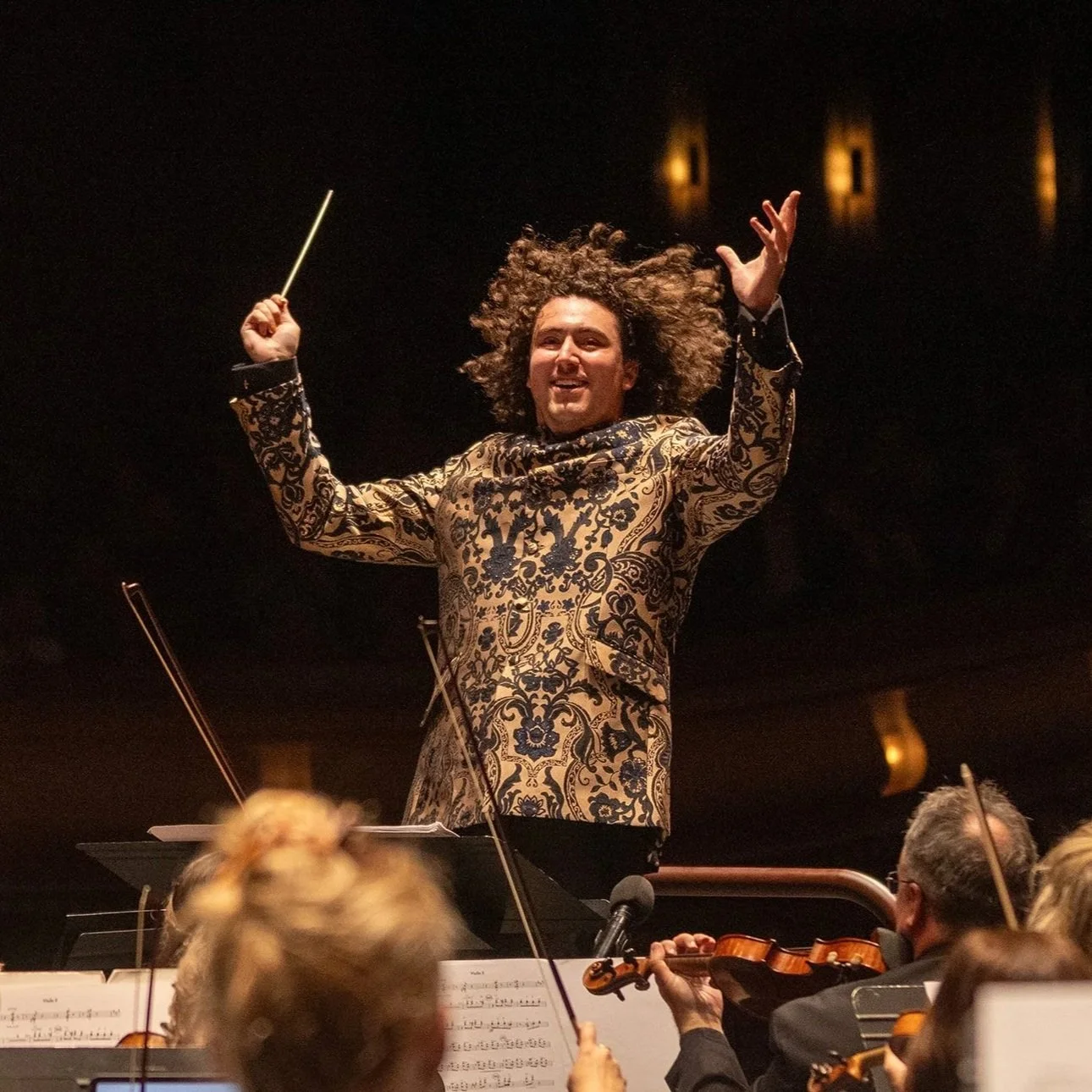
Alex Prior
Conductor

Julian Rhee
Violin
-
Winner of the prestigious 2024 Avery Fisher Career Grant, Korean American violinist Julian Rhee came to international prominence following his prize winning performances at the 2024 Queen Elisabeth International Violin Competition and the Silver Medal at the 11th Quadrennial International Violin Competition of Indianapolis. Rhee has appeared with the Milwaukee Symphony, Belgian National Orchestra, Antwerp Symphony, Württemberg Chamber Orchestra of Heilbronn, Indianapolis Symphony, Pittsburgh Symphony, Richmond Symphony, and San Diego Symphony alongside Francesco Lecce-Chong, Valentina Peleggi, Rune Bergmann, Antony Hermus and Leonard Slatkin, among others.
Equally passionate about chamber music, Rhee is the newest member of Chamber Music Society of Lincoln Center’s prestigious Bowers Program. He has performed at and attended festivals including the Ravinia Steans Institute, Marlboro Music, and NorthShore Chamber Music Festival, performing alongside esteemed musicians such as Vadim Gluzman, Jonathan Biss, and Mitsuko Uchida.
Rhee received his Bachelor’s and Master’s degrees as teaching assistant of Miriam Fried at the New England Conservatory, and currently studies with Christian Tetzlaff at the Kronberg Academy. Rhee is the recipient of the outstanding 1699 “Lady Tennant” Antonio Stradivari violin and Jean Pierre Marie Persoit bow on extended loan through the generosity of the Mary B. Galvin Foundation and the Stradivari Society
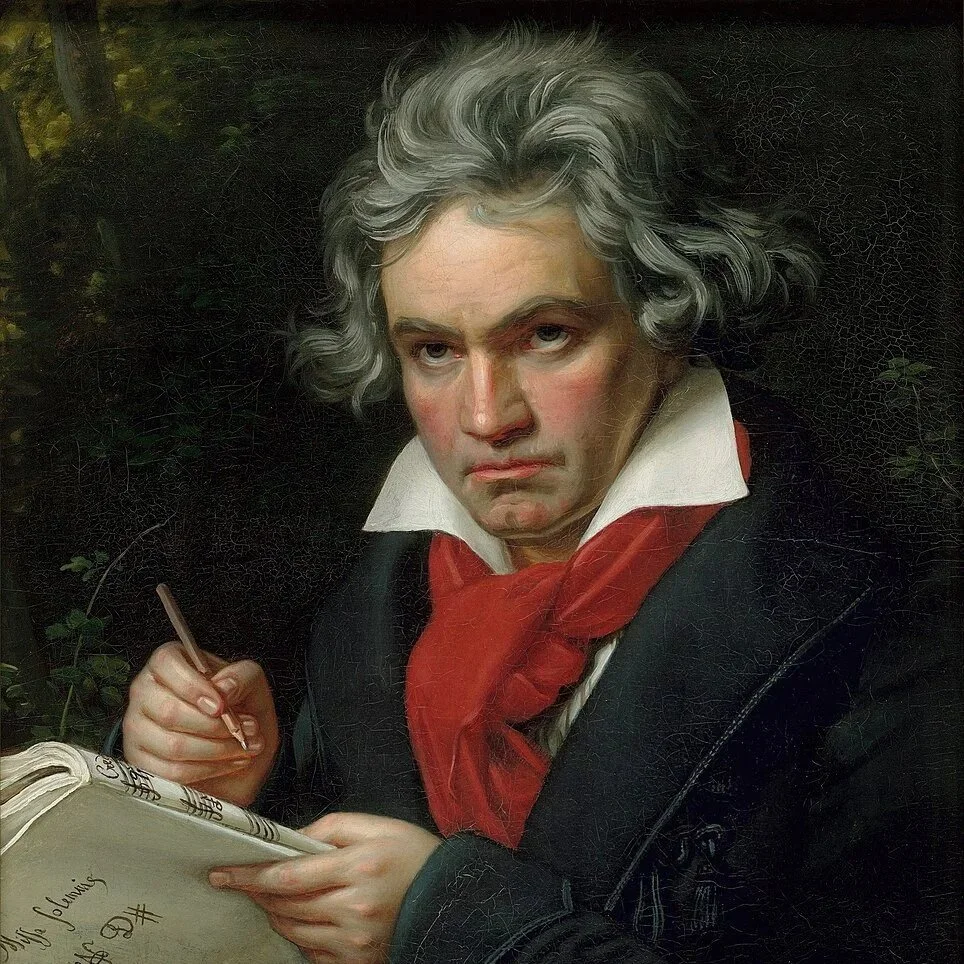
Ludwig van Beethoven
Composer