
Blast from symphony past: For one night only, maestro Giancarlo is back
Posted on Lookout Eugene-Springfield by Annie Aguiar | Jan. 12, 2026
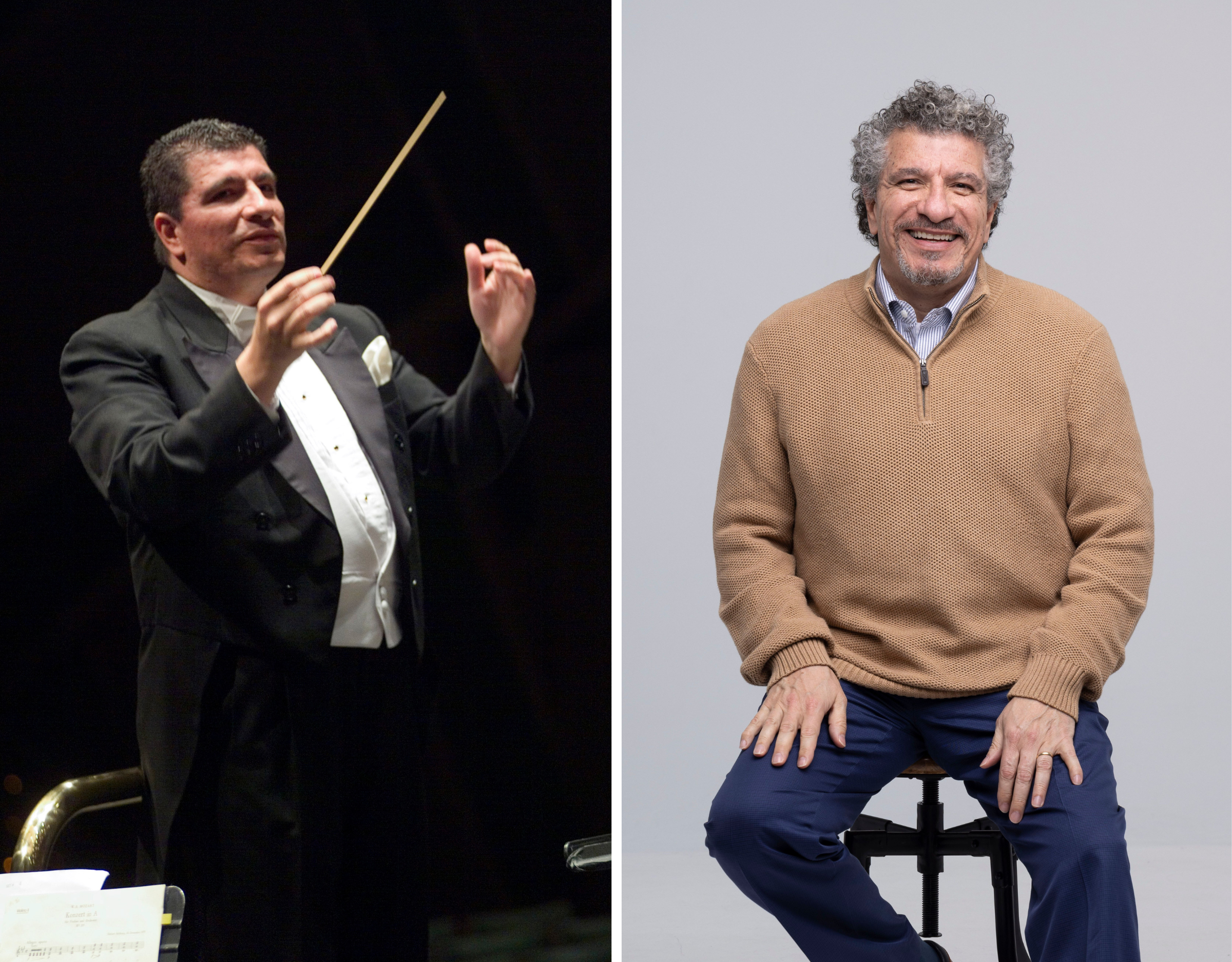
Even after six Grammy wins and a globe-spanning career peppered with leadership gigs at prestigious symphony orchestras, Giancarlo Guerrero has a special place in his heart for Eugene.
Guerrero was born in Nicaragua and raised in Costa Rica. His first role as a music director in the United States came when he was appointed to lead the Eugene Symphony in 2001. He was 32 years old.
Now, 25 years later, the 56-year-old music director-designate of the Sarasota Orchestra in Florida said the ask to guest-conduct during the symphony’s 60th anniversary season was easy to say yes to.
For him, the Eugene Symphony — where he was the third in a line of young music directors after Miguel Harth-Bedoya and Marin Alsop — was where he actually learned the ins and outs of what it takes to lead an orchestra.
“Nobody teaches you that in the conservatory,” he said. “You basically learn how to wave the stick and hope not to fall from the podium.”
In a Zoom interview from Costa Rica, Guerrero talked about his time in Eugene, the town’s appetite for adventurous programming, and what advice he has for young conductors like Alex Prior, the 33-year-old currently at the helm of the symphony.
This conversation has been edited for length and clarity.
Lookout Eugene-Springfield: You were 32 when you first came to Eugene to become the symphony’s music director. What did your life look like at that time? What did that opportunity mean for you?
Giancarlo Guerrero: When I came to conduct the first time during my audition, I always called the music director search a beauty pageant: You show up, you go through the process, you conduct the orchestra.
We only had one daughter, our oldest daughter, Virginia. I was the associate conductor of the Minnesota Orchestra, which basically means I was the “just-in-case guy.” Getting my own orchestra was the next step from being a staff conductor in a major symphony orchestra.
When we were there for my conducting debut, we found out that we were expecting our second child. Those children now are 26 and 23, so quite a lot of changes.
As I said, it all goes back to Eugene. It was the perfect place to nurture that, and to learn the ropes about what it really means to be the music director in a community like Eugene that is so proud of its orchestra. I carry it with me everywhere I go.
What did your time as music director for the Eugene Symphony mean for your career at large? Any big lessons or important moments?
As music director, sometimes conducting is the least of your problems. Having to deal with programming and what you put on, all of the performances, what pieces get to go, how do you sell this to an audience, marketing strategies, fundraising, having a direct connection with the community, attending all sorts of activities like Lions Club and Rotary Club meetings and all sorts of social encounters.
As you do these, you get better at it. You feel more comfortable speaking with different constituencies, with the orchestra, dealing with personal issues within the symphony as well dealing with a whole staff beyond the musical aspects of an orchestra. Nobody teaches you that in the conservatory. You basically learn how to wave the stick and hope not to fall from the podium.
The Chicago Tribune has praised what they called your “curatorial and interpretive creativity.” What did your time in Eugene mean for that development?
I was able to experiment. One of the most exhilarating and frustrating parts of being a music director is programming. When I come and I start thinking about a season, I start with 10,000 pieces, and then reality hits. I only have this many concerts, with this many dates and with this much money. Things start dropping out. You keep saying to yourself, “Next year, I don’t care what happens, I’m programming this next year.” A lot of it is just about the right moment, whether you have a piece in mind and you have a particular soloist. Everything that makes it into a season is almost like an accident of the universe.
People ask conductors a lot, “What is your favorite piece of music?” Well, whatever I happen to be conducting, because the conditions to make that piece make it to an actual program, whether as music director or as a guest conductor, I can promise you it is something that has been building up for me for several years.
This combination that I am doing in Eugene — no soloist, a Debussy’s “Prelude to the Afternoon of a Faun,” an early Mozart symphony that doesn’t get played very often, and the Symphonie Fantastique — I’ve never done that combination. I’m actually curious about how that’s going to work out.
So every performance to me is almost like a laboratory — I won’t know whether the combination will work until you play it in front of an audience. You may go, “You know what? That really didn’t work the way that I thought of it in my mind.” Or you say, “Oh my god, I discovered plutonium by accident.”
This is the perfect setup. That freedom to not be afraid, to push the envelope and not just go with your usual symphony or overtures, after a while it becomes routine. For me, even a piece like the Symphonie Fantastique, I want it to sound fresh again. I need to find a way to make it sound like we’ve never heard it before, and that we’re experiencing the way that audiences experienced 200 years ago. When you do that, the music becomes new again.
That aspect is both fascinating and exhilarating, but yet frustrating. You build up until the concert, and after the performance you start kind of making up your mind, you know: Does this work the way that I expected it? Would I want to do this again? In many cases, you say, “You know what, I want to do it again, but under different conditions,” because again, I don’t want it to be the same.
In other places that I conduct, you normally have two, three, four, performances of the same program, so you get to see it grow. In Eugene, you get that one chance. It’s almost like putting it on a pressure cooker.
You’ve worked as the music director in all manner of cities and symphony orchestras. What stands out to you about the Eugene audience’s tastes, or how far they’re willing to be pushed in terms of programming?
Because it is a college town, I would say that it has a very sophisticated audience. You also have to add that the very big deal in town was the Bach Festival during the summer. This is an audience that was not afraid to experience new things. Even though as music directors you kind of want to provide your audiences with the war horses, the stuff that we love — Tchaikovsky, Beethoven, Brahms, Berlioz — there was always room for us to also provide some of the newer voices.
This was always welcome, if presented in the right way. So in my case, not only did I present the music, but many of these composers came to Eugene, you know, made it even more special. I mean, people like John Adams and John Corigliano and Jennifer Higdon, Michael Daugherty, they all came to Eugene. It was not just playing their music; it was getting to know these performers up close.
The preconcert lectures were a huge part of it. I do know for a fact that for many audience members, they felt like they were being part of history. Imagine if you had a chance 200 years ago, and you were walking down the street in Vienna and you saw a poster that some guy named Beethoven was giving a performance. And guess what? There’s a preconcert lecture right before it. Knowing everything you know now, would you miss that? Of course not. I do feel providing that made the audience feel very special, that they were being part of history and promoting these composers that are now part of those war horses.
The symphony’s music director, Alex Prior, is also in his 30s, like you were when you started. Do you have any advice for a young conductor stepping into that role?
I know he has already a very stellar career, and Eugene is very lucky to have him. As I tell all young conductors — which is difficult when you’re early on and you want to conduct everything — you have to stay focused on really finding out who you are, developing that musical persona and the things that you want to make an impact.
You’re going to make mistakes — everybody does. But own them and learn from them. As long as you’re being honest with yourself, there’s not going to be an issue. Musically, get up there with authority. Know that music better than anybody, and put a stamp on it.
It’s not about getting people to agree with you. Try to get two musicians to agree with each other. Imagine 100. It’s impossible. What you want to see is conviction. I can totally see that he has the right personality for it, the right maturity.
Of course, I told him: “Put me on your speed dial.” You know, anything that you need in great confidence, just reach out and I’ll be happy to talk, even if it’s just to share conductor jokes.
Is there anything you’ve missed about Eugene that you’re looking to check out when you’re back in town?
I missed the rain. People used to warn me about it. Well, I come from Costa Rica. We have two seasons, rain and more rain, so that was kind of charming for me.
How to see ‘Giancarlo Guerrero Returns’
Guerrero will be conducting the Eugene Symphony’s performance of three pieces of music:
Claude Debussy’s “Prelude to the Afternoon of a Faun”
Wolfgang Amadeus Mozart’s Symphony No. 31 “Paris”
Hector Berlioz’s Symphonie Fantastique
There will be no featured soloist, but there will be two harpists on stage for the Debussy and Berlioz sections of the program.
In addition to the performance, symphony executive director Dave Moss will interview Guerrero in a preconcert talk beginning at 6:30 p.m. in the Hult Center Studio, downstairs from the lobby.
When: Thursday, Jan. 15 from 7:30 p.m. to 10 p.m.
Where: The Silva Concert Hall in the Hult Center
Tickets: Available online, starting at $22